

Key takeaways
-
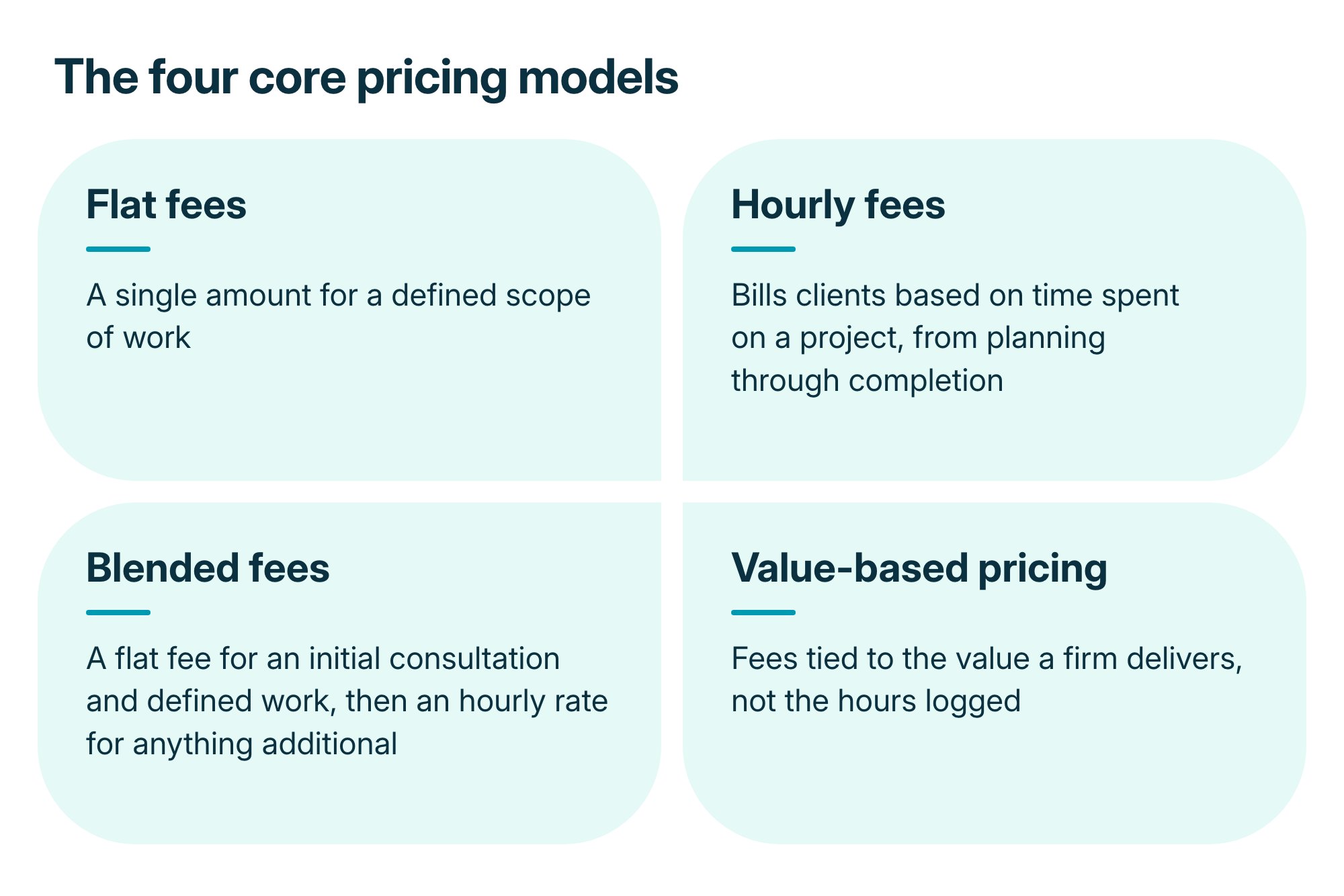
Accounting firms typically choose among four core pricing models: flat fees, hourly fees, blended fees, and value-based pricing.
-
Flat fees work best for straightforward client needs and can serve as an entry point before a client's work grows in scope.
-
Hourly fees give clients visibility into billed time, but firms need clear expectations about scope changes and unplanned work.
-
Value-based pricing ties fees to the outcomes a firm delivers rather than to hours logged, allowing firms to decouple profitability from time worked.
-
Fee funding allows clients to pay for accounting services in installments, while the firm still receives the full invoiced amount upfront.
Fee funding options took off during the pandemic, and many consumers now see them as a standard way to pay, including for accounting services.
That matters because the client experience carries real weight. One bad interaction can send a client to a competitor, and a pattern of them can end the relationship for good. A SuperOffice survey of nearly 2,000 business professionals found that customer experience was the top priority for most businesses over the next five years.
So it pays to meet clients where they are and give them choices that work for their situation. Flexible payment options are one of the simplest ways to do that. Fee funding lets clients take on high-value services now and pay over time, which puts them in control of their payment schedule. That control can improve satisfaction and loyalty in a way traditional payment methods often don’t.
In this article, we’ll cover:
-
Strategies for using fee funding to elevate your client experience
-
How to price accounting services and achieve better outcomes for clients
-
Traditional payment methods and where they fall short
-
How your firm can stay ahead in today's customer-centric landscape and secure long-term success
Top pricing strategies for accounting services
As client expectations shift, more firms are pairing pricing models with flexible payment options , such as professional fee funding, giving clients more control over how they pay. Here's a look at the most common pricing strategies for accounting services:
-
Flat fees
Flat fees charge a single amount for a defined scope of work. Firms serving clients with smaller, more straightforward needs often use this model, since it limits client interaction to one or two meetings. Flat fees can also work as an entry point for clients whose needs and fees will grow over time.

-
Hourly fees
Hourly fee billing is based on time spent on a project, from planning through completion. Clients can see exactly what they’re paying for, but firms still need to set clear expectations about scope changes and the added cost of unplanned work.

-
Blended fees
Blended fees combine models, often starting with a flat fee for an initial consultation and defined work, then shifting to an hourly rate for anything additional or unplanned. This structure provides clients with transparency while ensuring the firm is compensated for the full value of the work delivered.
-
Value-based pricing
Value-based pricing ties fees to the value a firm delivers, not the hours logged. Charging a flat rate per package or service lets firms decouple profitability from time worked and focus on client outcomes.
Learn more about applying this model in this e-book .
What is fee funding for accountants?
Fee funding for accountants is a payment plan option that allows clients to access services now and pay for them in installments. The accountant or firm gets paid in full upfront, regardless of whether the client completes their payments. This gives clients a way to get the services they need without covering the full balance immediately or turning to other lending options.
For the firm, that means predictable cash flow without having to manage a payment plan or chase unpaid balances. It’s a way to say yes to clients who need a payment option that fits their budget.
Accounting fee funding vs. traditional payment plans
Fee funding and traditional payment plans share some common ground, but the right choice depends on your firm and your clients. Below, we’ll take a look at where each option holds up and where it falls short:
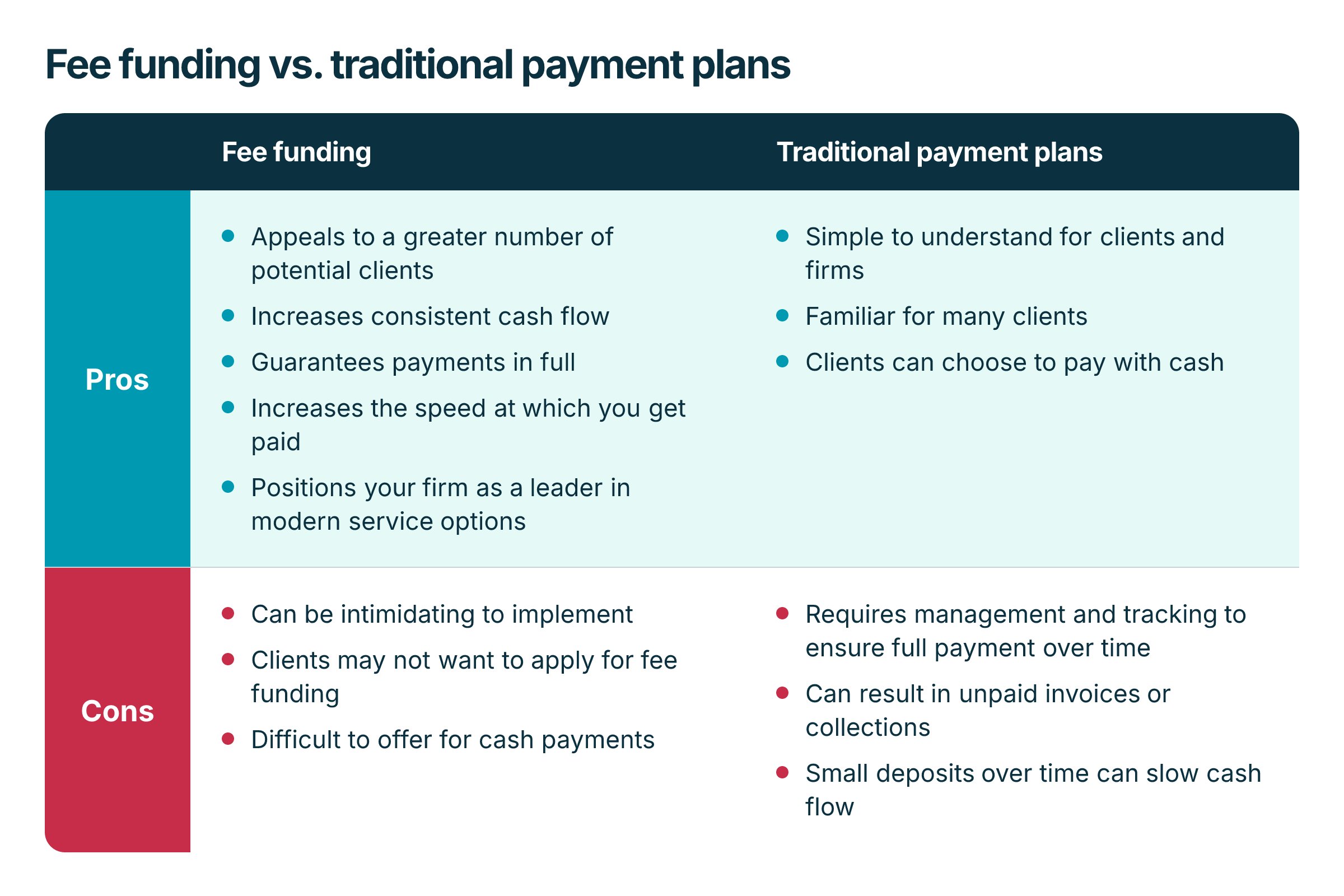
Fee funding
Pros:
-
Appeals to a greater number of potential clients
-
Increases consistent cash flow
-
Guarantees payments in full
-
Increases the speed at which you get paid
-
Positions your firm as a leader in modern service options
Cons:
-
Can be intimidating to implement
-
Clients may not want to apply for fee funding
-
Difficult to offer for cash payments
Traditional payment plans
Pros:
-
Simple to understand for clients and firms
-
Familiarity for many clients
-
Clients can choose to pay with cash
Cons:
-
Requires management and tracking to ensure full payment over time
-
Can result in unpaid invoices or collections
-
Small deposits over time can slow cash flow
Which accounting pricing structure is best for your clients?
The best structure is the one that fits the client’s needs and your firm’s workflow. Flat fees suit clearly defined work; hourly billing suits projects that are hard to scope; blended fees cover both; and value-based pricing works when your fee is tied to a clear outcome. Many firms mix models and match each one to the client.
Whichever you choose, the payment experience matters too. Flexible options like fee funding let clients pay in ways that fit their budgets, and CPACharge’s billing tools reduce manual invoicing and follow-up on unpaid balances.
How to offer clients professional fee funding
Whichever pricing model you choose, how easily clients can pay you shapes how they see your service. Not every fee funding solution understands the accounting industry’s compliance needs, billing structures, and client expectations. CPACharge offers an accounting fee-funding solution, powered by Affirm, designed specifically for accounting professionals. It also reduces manual invoicing work and the time your team spends following up on unpaid balances.
CPACharge allows you to receive the full invoiced amount upfront, while your clients pay in installments with Pay Later . A third-party lender, Affirm, handles the collection of installment payments, and you’re never responsible for the unpaid balance.
Getting started is straightforward: enable Pay Later at checkout or on your invoicing platform, and clients will automatically see financing options at checkout. There’s no extra paperwork for your firm to complete, and no change to how you generate invoices or track payments in your existing accounting workflow.
Choosing the right payment tools matters as much as choosing the right fee structure. Firms that pair fee funding with payment solutions for solo accountants and secure payment processing can offer clients a consistent experience across invoices, retainers, and installment plans, without adding new month-end reconciliation work.
Make paying you easy
Providing a good client experience includes making it easy for clients to pay you. Fee funding gives them a payment option that fits their budget and spares your team from chasing payments.
To see how CPACharge can simplify your billing and help you get paid faster, book a demo today.
